Two Hours, One Umbrella, and Zero Errands: Playing Tourist on Your Own Streets
Photo: Carlquist, Sherwin John, 1930-2021, CC BY 4.0, via Wikimedia Commons
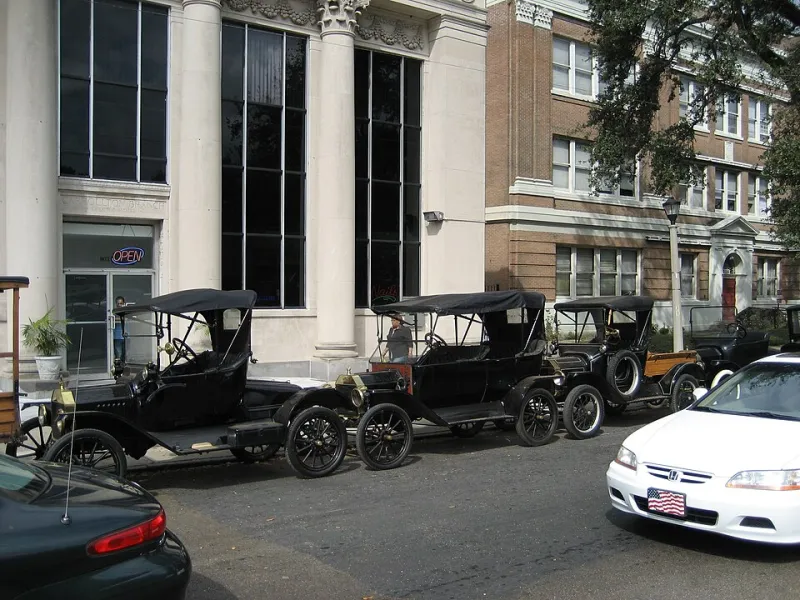
There is a building four blocks from my apartment that I had walked past maybe six hundred times before a stranger with a flag told me it used to be a vaudeville house, and that the bricked-up arch on the side was where the stage door had been.
I'd been living there for nine years. I'd never once looked up.
That's the whole pitch for the free walking tour, honestly. Not the travel savings, not the history trivia. It's the humbling, slightly embarrassing discovery that you have been a tourist in your own life this entire time, and that two hours with a guide can fix a surprising amount of it.
The errand-industrial complex
Here's how a normal Saturday goes. You wake up with a list. You drive to the hardware store, the grocery store, the place where you return the thing you bought wrong. You come home at 4 p.m. vaguely tired and unable to name a single thing you saw.
We've quietly converted leisure time into logistics time, and then we wonder why our neighborhoods feel like a backdrop. The walking tour is the cheapest rebellion available. It costs you one afternoon, involves no planning, and ends with you knowing where the oldest tree in town is.
Finding one takes about ninety seconds
Search your city's name plus 'free walking tour' and you'll get results — the tip-based model that started in European capitals has thoroughly arrived in the US. You'll also find tours run by historical societies, downtown business alliances, library systems, parks departments, university extension programs, and neighborhood associations, many of them genuinely free with no tipping expectation at all.
Worth checking:
- Your local visitors bureau website (yes, even though you live there)
- The city historical society's events calendar
- Local subreddits, where guides post routes
- Jane's Walks, the free neighborhood-walking festival held in cities around the world each May
- Your library's community board, which is where the good weird stuff lives
Pick the route through the neighborhood you think you know best. That's where the surprises are.
Yes, you tip. Here's how much.
Tip-based tours are free to book and pay-what-it's-worth at the end, which means the guide is working for tips and the awkward moment is entirely on you.
A reasonable baseline in the US is $10 to $20 per person for a standard two-hour tour, more if the guide was excellent. Bring cash — a lot of guides prefer it, and some can't process cards. If you only have a phone, ask at the start whether they take Venmo or a QR code. Nobody will be offended. They will be mildly offended if you vanish.
One more note: if you booked through a platform and it charged a 'booking fee,' that money did not go to the guide. Tip separately.
What two hours does to your affection for where you live
This is the part nobody advertises. Learning the story behind a storefront changes how it feels to walk past it. You stop being a person who lives near things and start being a person who lives among things.
There's a specific warmth that shows up around minute forty, when the guide points out something ridiculous — a hydrant painted like a firefighter, a plaque for a horse, a building that was a bowling alley and is now a bank and is about to be a taco place — and the whole group laughs together. Twelve strangers, one shared joke, and suddenly your town has characters in it.
You also get a free mental map upgrade. Guides route you down alleys and through plazas you'd never choose. I now know which block has the good shade at 2 p.m. and which coffee shop has outlets. That's not trivia. That's operational joy.
Go alone, or bring the friend you keep rescheduling
Solo is genuinely great. You set the pace, you can ask the guide a borderline-too-specific question, and nobody judges you for stopping to photograph a doorknob.
But the tour is also the ideal low-pressure friend date, because it solves the two hardest problems of hanging out: what to do, and how long. There's a built-in itinerary and a built-in ending. You don't have to fill silence. You can leave after, or suggest a drink, and either choice is fine.
Invite the person you've been meaning to see for four months. Say: 'Two hours, Saturday, we walk around and someone tells us stuff.' It's the easiest yes in the world.
Small logistics that make it better
- Arrive ten minutes early. Tours leave on time and the group is harder to find than you'd think.
- Wear the boring shoes. Two hours becomes three when the guide gets excited.
- Bring water and a rain layer. Tours run in drizzle and drizzle is often the best version.
- Tell the guide you're local. They light up, and they'll point you toward the stuff tourists never ask about.
- Ask the weird question. 'What's the oldest business still open?' 'What building has the best ghost story?' This is the whole reason they're there.
- Tip at the end, in cash, with eye contact. Say one specific thing you liked. It costs nothing and it makes their week.
Two hours. One umbrella. Not a single errand. You'll come home with a slightly rearranged affection for the place you already live, which is a strange and genuinely good thing to be able to buy for fifteen dollars.